
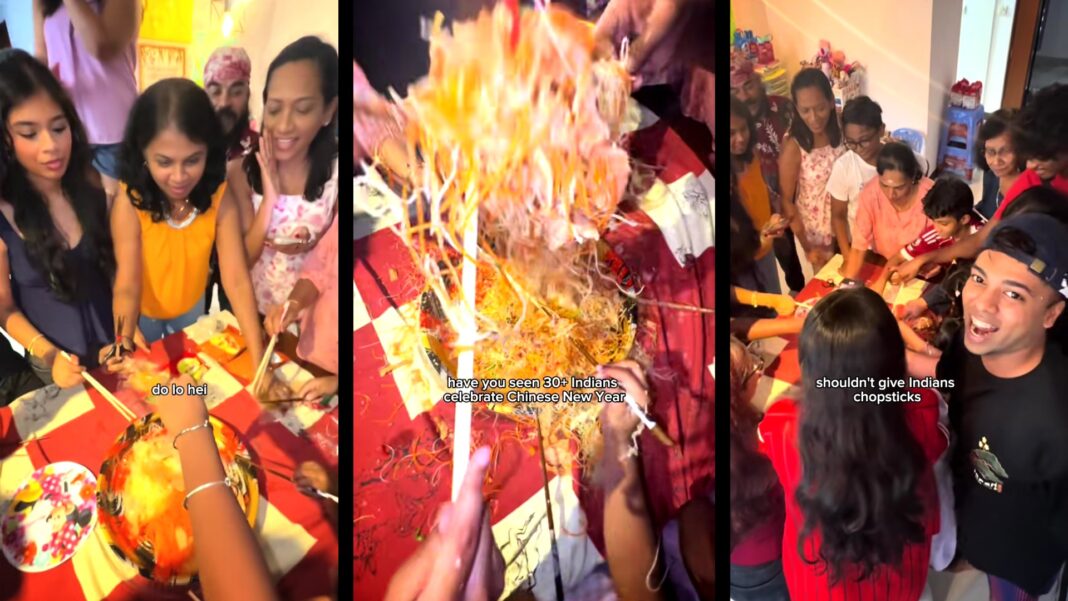

SINGAPORE: An Indian household’s annual Chinese New Year (CNY) gathering tradition draws cheers and reflections online about what racial harmony should look like in Singapore.
Over 30 members of the Indian family gathered under one roof to celebrate the Chinese New Year this week. Many Singaporeans said the energy felt warm, loud and joyful in the family’s video, the kind of celebration that reminds people what the festive season should be all about.
The video creator Abraham De Laure posted the clip on Feb 18. It showed three generations working side by side to prepare food. Some wore red outfits and traditional Chinese clothing. Later, the family tossed yusheng, shared hot pot, exchanged oranges and handed out red packets. The younger members knelt before the elders to offer their New Year’s respect and greetings. The scene looked busy, but organised. Laughter filled the room.
@abrahamdelaure Family celebrates Chinese new year #cny2026
On TikTok, the clip drew over 300,000 views and nearly 30,000 likes. Many praised the family’s effort, with a few Chinese commenters joking that it looked even livelier than their own reunions. Others pointed to it as a good example of racial harmony in Singapore.
De Laure told 8world News that this is the fourth year his extended family has celebrated Chinese New Year together. The clan has more than 70 members, and over 30 attended this year’s event. He also shared that his family includes members from different races, so celebrating various festivals has always been normal for them. Chinese New Year just adds another reason to come together to celebrate.
Each year, they also make a point of learning more about Chinese customs. For example, they now understand that each ingredient in yusheng carries a wish for prosperity, health or good fortune. They also learned that oranges should be given in pairs, as a sign of abundance.
In the video, De Laure added that the family adjusted some dishes to suit the different dietary needs of the family members. And as not everyone eats raw salmon, his aunt cooked the fish in mala soup before using it for the yusheng. Certain meats were also avoided, so everyone could enjoy their meals comfortably.
The video resonated well with many Chinese Singaporeans because it didn’t stray too far from just celebrating CNY and showed a family enjoying their time together. As the Chinese New Year is about reunion dinners and family bonds, this family gathering kept that core intact, and even though the faces may not match old stereotypes, the spirit sure did.
The supportive online response also suggests that people are drawn to and appreciate such scenes because they are rare and reflect the kind of society many hope to see more often: open, curious and respectful to other races and cultures.
De Laure said that learning about other cultures has always been important in his family, so that positive attitude may be the main story here and a good example for others to reflect on and learn from as well.
 Follow Google News
 Join us on WhatsApp
 Follow us on Telegram